
“We Are Also in Bondage Here”
How Seattle bowed out of the civil rights conversation, and why Quin’Nita Cobbins-Modica is dragging it back in.
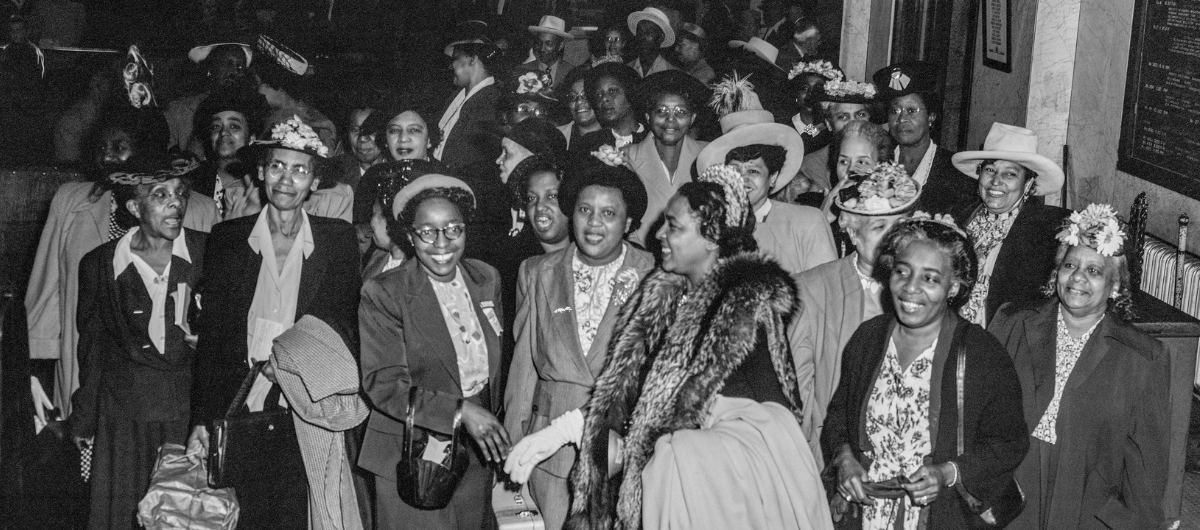
History favors giants. This is, in part, human nature—to remember the darkest atrocities, the noblest martyrs, the underdogs faced with the direst odds. But the reality of the past is often more nuanced, and from this nuance springs the kind of conversations Quin’Nita Cobbins-Modica wants to have.
The scholar and historian focuses on African American women’s history in the United States, looking particularly at civil rights history, leadership, and politics. Cobbins-Modica’s analysis of Black activism exists in the intersection of gender and race, past and present, national and local. In the shadow of civil rights moments like Selma, Alabama’s “Bloody Sunday,” or the March on Washington, African Americans in the American West fought against a quieter violence—which sprang from the same insidious root.
Doubly overlooked in this Southern-focused narrative are the Black Washington women whose activism played a pivotal role in civil rights efforts both within the state and on a national scale. In nationally recognized groups, through small local grassroots campaigns, and as individuals, they fought to combat Seattle’s racist and segregationist practices that lurked beneath a veneer of perfunctory equality. Cobbins-Modica, who is currently in the midst of writing a century-long history of Black women’s activism in Seattle, focuses on the particular “political ferment” of 1960s Seattle in a talk for Humanities Washington, “We Are Also in Bondage Here: Black Women in the Washington Civil Rights Movement.”
Where does Washington fit into the larger civil rights narrative? What—and who—has been overlooked? And what might the profound achievements owed to Black women in this period teach us about addressing the issues that define today?
The following interview has been edited for length and clarity.
Humanities Washington: Why is Washington State seen as an “exception” rather than a microcosm of U.S. society?
Quin’Nita Cobbins-Modica: Washington State, in the popular imagination, is seen as this racially progressive—and subsequently exceptional—place. What I mean by that is that it’s seen as being more racially tolerant, without much of the racial issues that other cities may have experienced. This is due, in part, to its early civil rights laws that were on the books in the late nineteenth century: collectively, Black men and women, especially by 1910, could vote unencumbered. For Black people, there were not really any legalized forms of segregation or profound instances of racial violence—to a degree.
At the same time, there did exist, of course, laws and legal barriers for Indigenous groups and Asian American groups, especially the Chinese—both of whom experienced varying forms of racial violence and vitriol. Even in the absence of legal barriers for Black residents, there has always been a color line, or Jim Crowism that existed in the state. In that sense, it doesn’t make Washington State that different from other parts of the U.S.
I complicate this idea, or myth, of Washington being exceptional through the examination of Black women’s activism, and to understand the ways they consistently fought against what we call de facto racial segregation. De facto segregation is discrimination by custom and practice. It’s not necessarily something that’s legalized. Whereas de jure is legalized, which is what you would find in the American South.
I explore how Black women exposed and challenged this color and gender line on multiple fronts: particularly in housing, education, and employment. Essentially, by the 1960s, they understood that their perceived relative freedoms in the state (and what I mean by “relative freedom” is the absence of the legal barriers, with the exception of racial covenants) were precarious. They had to be vigilant in advancing Black freedom and expanding women’s rights against the forces that sought to undermine their humanity and citizenship.
In a letter written to Dr. King, one of the women I highlight drove home this point. She drew a connection between Black struggles here and Black struggles in the South. She argued against the notion that Black people have an exceptional life in Washington. They encountered covert forms of oppression and, quite frankly, were not free at all, because she recognized that Black freedom in the PNW was tied up with the freedom— or unfreedom—of those in the Jim Crow South. They did not deal with racial violence, per se, but they dealt with high unemployment rates, residential segregation, school segregation, and other societal barriers throughout the state. She contended that Black Pacific Northwesterners, collectively, were feeling the weight of oppression and white supremacy that was having the same impact on Black life here.
“Many people often associate the civil rights movement as a Southern phenomenon and are unaware that a movement existed here in Washington State. It was indeed a nationwide movement.”
What did the activism of Black women look like in the height of the civil rights movement?
We can start with the 1940s when we began to see a surge in Black activism due to wartime migration. Black women were involved in concerted efforts and campaigns to challenge racial discrimination and segregation here in Washington State—one of them being employment discrimination. You have groups of women representing different organizations, such as the Seattle Ladies’ Auxiliary of the Brotherhood of Sleeping Car Porters [a labor union founded to improve the working conditions of those employed by the Pullman Company]; also, women in the NAACP [Women in the National Association for the Advancement of Colored People]; the Association of Colored Women’s Clubs, and to a certain degree women in the Urban League. They all fought to secure a fair employment practices law [the Washington State Law Against Employment Discrimination], which was one of the first in the nation to ban racial discrimination in employment. That occurred in 1949.
A law is only effective if it’s enforced. Even though the Fair Employment Practices law banned racial discrimination in employment and had a provision that established a state board against discrimination, it was somewhat ineffective. Black women had to continue to fight for the enforcement of these laws in the 1950s. By the time we get to the 1960s, many joined new organizations such as CORE [Congress of Racial Equality], where they engaged in non-violent direct action campaigns and strategies borrowed from the Southern movement. Many women went out to stores to fight head-on with those businesses that wouldn’t hire Black folks. They worked through negotiation, boycotting, and picketing in order to force private businesses—like Nordstrom, the Bon Marche, and Safeway—to hire African American workers. Over two dozen Black employees, for example, were hired because of that direct action campaign (this was in 1962), but that was just a small victory in changing that social policy.
Another example is women organizing, again through CORE, the NAACP, and the Urban League to eradicate housing and residential discrimination. For instance, they fought to get an open and fair housing policy passed through the Seattle City Council. Vivian Caver set up human rights councils in a number of white neighborhoods in King County to try to win white support for fair housing legislation. She would go on to head the Seattle Human Rights Department in 1975. Women’s efforts in helping to drive those campaigns led the Seattle City Council in 1968 to pass a housing ordinance that prohibited unfair and discriminatory housing practices. This also came at the same time Congress passed a federal act to ban housing discrimination across the nation.
Another profound area of activism was education. Again, Black women—through the NAACP, CORE, and other organizations—banded under the leadership of E. June Smith, president of the Seattle NAACP between 1963 and 1968. She helped lead a two-day boycott of the Seattle Public Schools in 1966 because of the school board’s inaction to integrate the public schools. Due to the ongoing education demands, by 1978, the Seattle School Board instituted a voluntary desegregation plan without a court order–which remains controversial. Many community members, especially Black mothers and parents, didn’t particularly like the fact that their children were being bussed to white schools, nor did they support the closure of their neighborhood schools, which exacerbated the internal conflicts within the community on the direction of the civil rights agenda. For the most part, though, Black residents were very much committed to desegregating the school system, eradicating racial inequities, supporting the hiring of Black educators and administrators, and ensuring that their children received a quality education.
Was your focus more on groups of women activists or did you look at individuals?
I’m looking at both individual and collective efforts by Black women. Women helped to devise strategies, disseminated information, gave speeches, wrote correspondence, picketed, boycotted, facilitated meetings, and provided leadership and resources to the many organizations. They often held multiple memberships. So, I’m interested in women who worked through organizations and also those who worked independent of them as well. They did not all necessarily agree on strategy, method, or even what issues to prioritize.
Like the woman who wrote the letter to Dr. King. What was her name?
Yes, that’s where I begin the talk to frame the discussion. Her name is Freddie Mae Gautier. She was a Seattleite and, at that time, a clerk in the King County Sheriff ’s Office. She was also a very respected community organizer and helped co-found the Western chapter of the Southern Christian Leadership Conference, founded by King and a cohort of Black ministers in the South. She was also a founder of the Benefit Guild, which emerged in the aftermath of the 1963 Birmingham church bombing that killed the four little girls. They raised money for the families.
In her letter, she urges King to come to Seattle, to the Pacific Northwest. She clearly outlines the conditions and the specific grievances that Black people are facing here: she says, essentially, “We’re having some of the same problems that exist in the South, but a lot of people can be complacent here. We need you to come.” She was very much concerned with Black women who were on the front lines in the South—because, she said, we are also ready to act, and we’re going to be on the front lines as well of this movement for justice.
She’s just one of the individual women I mention. I focus on others: Vivian Caver, who worked with the Urban League and held workshops to teach and encourage white residents about the importance of supporting open housing legislation; and E. June Smith, who was arguably one of the most visible Black women leaders at the forefront of the movement.
Another person I highlight is Roberta Byrd Barr, who was an educator in the Seattle Public Schools. She also ran a television program called Face to Face to address the racial issues Black people were experiencing in this city and in the state. In the height of the [Seattle Public Schools] boycott, she invited members of the school board to engage in a public discussion around school integration. She also traveled the state advocating for Black history and designing culturally responsive curricula for teachers to implement in their classrooms. She believed there needed to be intensive training for educators in relating to students of color and Black students—as the school districts underwent significant changes to address school integration and the push for bussing.
Those are just four of the six or seven women I highlight in the talk. Of course, there are more!
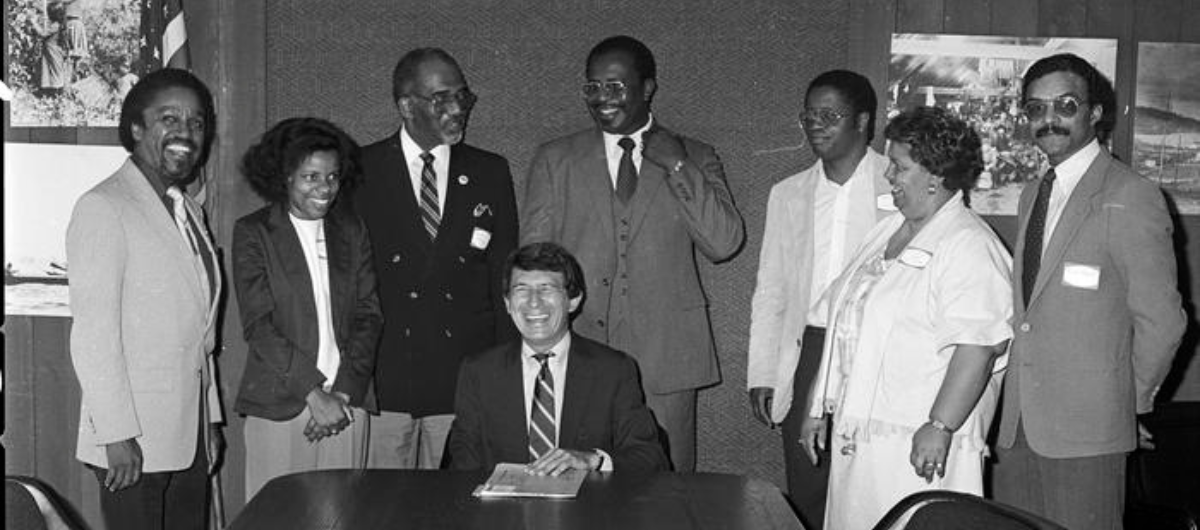
Image: A signing ceremony and reception attended by Freddie Mae Gautier (on the right) officially recognizing Martin Luther King, Jr. Day as a City holiday. Photo courtesy of the Seattle Municipal Archives.
Is the talk mostly expository, for the purpose of highlighting these women and these organizations that haven’t really been highlighted, or is there a way that this history maps onto today that you hope audiences take away?
My purpose is never just to highlight, to just say “Black women were there.” Instead, it is critical to understand the significance of their experiences and involvement. One of the main takeaways is to show that by centering Black women’s leadership and activism within a local context, we allow for a more nuanced understanding of the unique circumstances of the Black freedom struggle in this region that necessitated both similar and different protest strategies to combat racial discrimination and de facto segregation. Many people often associate the Civil Rights Movement as a Southern phenomenon and are unaware that a movement existed here in Washington State. It was indeed a nationwide movement.
Another major takeaway is the various ways that Black women have been on the front lines for social justice and change. As I mentioned before, many of them spearheaded multiple campaigns but are rendered invisible and marginalized in PNW and civil rights history.
A third takeaway are the lessons we can draw from women about the strategies they employed in the past to address some of those same issues we are facing today. Engagement in social justice work requires education. Black women activists educated themselves about the issues and their roles as citizens. They also educated others. They organized, strategized, and built coalitions—like Vivian Caver and women in CORE, for example. With such a small Black population, they needed people power, and to work with other groups to challenge these institutional barriers. It was, therefore, important to engage in coalitional politics for large-scale change to occur.
The ways that Black women conceptualized freedom can help us to (re)think what freedom means today, and it provides a lens for us to understand our contemporary moment and women’s place within it. I discuss the newer generation of Black women— some who have taken up the mantle and are continuing the work of the Black freedom struggle on the grassroots level, using some of the same direct action strategies and tactics of the past; and there are others who are using their government and leadership positions to create policies through the legislative process to address systemic racial, gender, and economic issues. There are still the same struggles around poverty, fair wages, housing insecurity, healthcare, and education–therefore, the freedom movement continues.
Ariana Sutherland is a freelance writer based in Seattle.
Quin’Nita Cobbins-Modica is currently touring the state as part of Humanities Washington’s Speakers Bureau, giving a talk called “We Are Also in Bondage Here: Black Women in the Washington Civil Rights Movement.” Find an event near you or online.