
Story Core
It wasn’t just the orchards. How innovative advertising and transportation methods made Washington the Apple State.
Amanda L. Van Lanen grew up in Saipan, an island north of Guam, where Red Delicious apples were available at her local grocery store year-round. Despite disliking how they tasted, the fact that these apples were accessible to an island in the Pacific Ocean amazed her. This curiosity would lead to her academic career, where she earned a PhD in history at Washington State University and wrote her dissertation on the industrialization of the apple.
Van Lanen currently teaches history at Lewis-Clark State College. Her dissertation-turned-book, The Washington Apple: Orchards and the Development of Industrial Agriculture, examines how economic factors, promotional strategies, and infrastructure development transformed Washington into a major apple-producing region.
This interview has been edited for length and clarity.
Humanities Washington: Can you briefly tell us about how apples became so popularized in Washington?
Amanda L. Van Lanen: Part of it has to do with the railroads. When they were building them across the West, they were looking for the best economic use of the land. When they were looking at parts of Washington, especially parts that needed to be irrigated, [they had] to have a crop that would be profitable enough to support the cost of irrigation. Apples were the one thing that could be sold for a profit and also be stored long enough to be shipped all over the country without spoiling. That’s partly why they chose them.
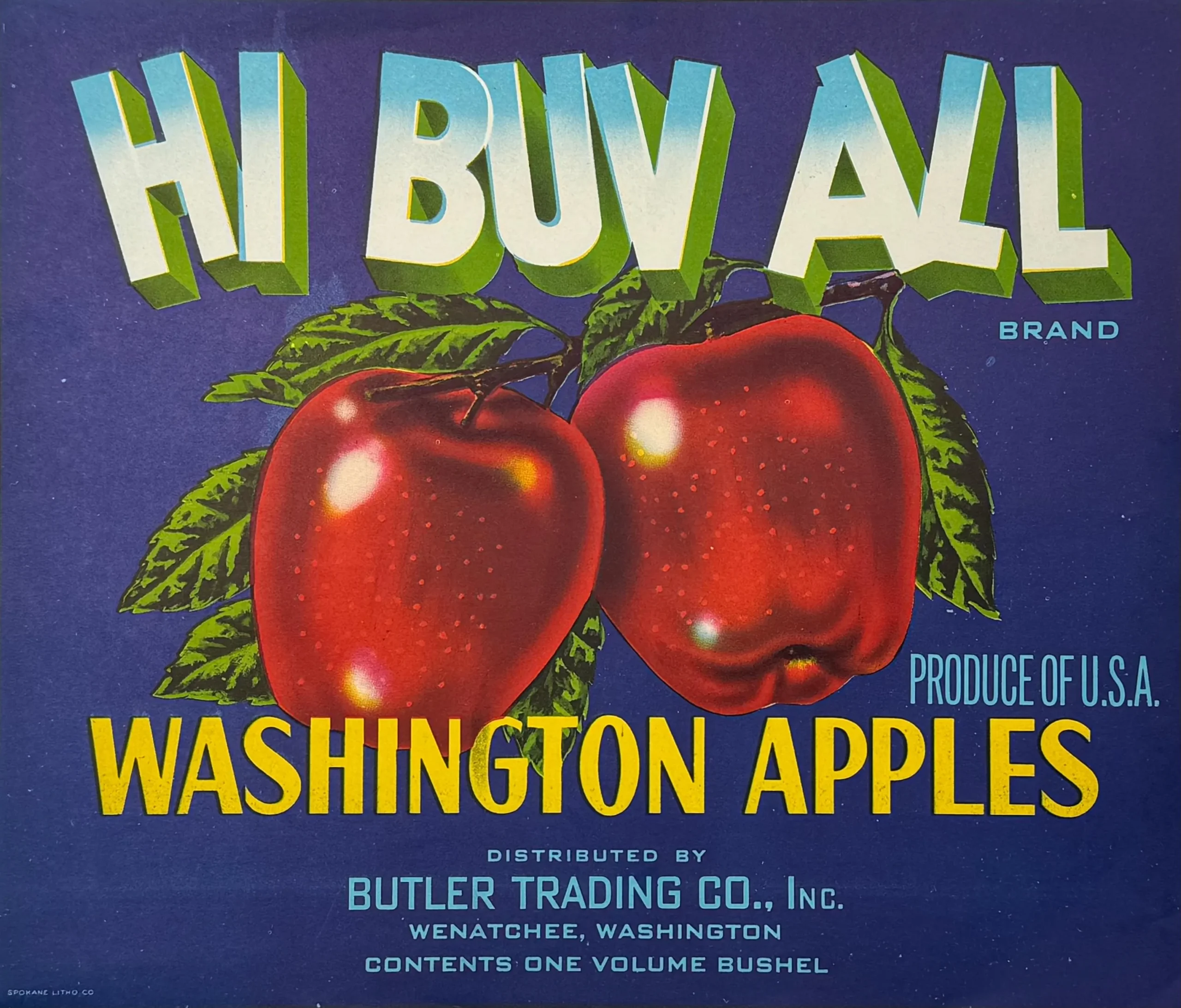
But on top of that, there were some crop failures back East that put Washington growers in the market. Washington also very early on had to advertise their apples with giveaways, cookbooks, billboards, posters, and even films. Silent film stars in the 1920s made promotional films for the Washington apple industry. I haven’t been able to track down the originals; I don’t know if they still exist. But I’ve seen still shots from them. [That publicity caused consumers] to associate Washington with apples.
What has been the most surprising thing you’ve learned through your research on how apples became so industrialized?
When I’ve given this talk, especially when I went outside of Washington, the thing that surprises people the most is that the place where we grow apples is a desert. It doesn’t make a lot of logical sense, because the primary [apple] growing regions in Washington get less than 10 inches of rain a year. Everything has to be irrigated, and that really runs counter to people’s mental image of lush apple orchards and everything being green and pastoral.
The thing that I found most surprising, as I was starting to research, is how much the railroads were involved. Because the railroads were really instrumental in not only providing transportation, but they were friends with all of the major players in the apple industry. They helped in various ways by financing irrigation, canals, and other infrastructure that the apple industry needed.
 How exactly did you get started writing your book, and what motivated or inspired you?
It was actually my PhD dissertation, so that’s kind of the core of it. But then, I just really was motivated to tell this story. It’s such an interesting story, going all the way back to the first apple tree in Washington State and all the way to the present.
A lot of the records I worked with were from the Minnesota Historical Society, which were the railroad records. The fabulous thing about those is they have both sides of the correspondence. You can really see the conversations people were having, what they were thinking, and how they were communicating with each other. This is not always the case with historical research, you don’t always get both sides of the conversation. So it was a lot of fun.
Bigger than just apples, what do you hope Washingtonians walk away with after your talk?
Food systems are complicated. One of the things in recent conversation is climate change and how that affects our food systems. We know the pandemic-affected distribution systems, and questions of equity when we’re thinking about things like healthy food and organic food and which communities have access to those things and which don’t.
I hope that’s something that will open up the conversation because on the one hand, apples are an industrial product. There are a lot of inputs that go into them. They use a lot of pesticides and things that aren’t always great for the environment. On the other hand, it enables people to have access to fresh fruit at a very low cost. So that’s a complicated thing that we have to wrestle with. I would like people to just think about that complexity and those tensions. There’s not always an easy answer. But hopefully, understanding how we got to this point can help us think about how we move forward.
Now for the fun questions, what is your favorite apple?
I buy them from my local orchard, and he grows Galas and Fujis. So that’s what I tend to get the most, two miles from my house. They’re fresh. They’re amazing.
What are your go-to foods to cook with apples?
Apple pie of course. My family really likes pie. Or apple crisp. I make a lot of apple crisps because it’s faster than a pie.
Can you help settle the apple pie debate: Which apple is the best to make pie with?
I don’t think there’s many grocery store apples actually that make great pies. In my opinion, they’re all too sweet. So when I make apple pie, I usually put in some cider vinegar and lemon juice because they’re all too sweet for me.
Texturally, some of them turn to applesauce when you bake with them. Historically, they grew apples that were good for cooking and apples that were good for eating. Predominantly now, the commercial ones we produce are the eating type. We tried a taste test this winter where I made five different varieties. We concluded that Fuji made the best.
Do you have any apple recommendations for readers to try?
If you do have a chance, at a farmers market, try any of the old heirloom varieties. There are some orchards that are experimenting with those older varieties that have been lost commercially. There are thousands of varieties of apples that people used to grow that we’ve kind of lost. There’s one called Wolf River. They grow Winter Bananas at the research farm at WSU and different kinds of Jonathans and Macintoshes.
And just be adventurous and try whatever your grocery store offers, because it seems like every time I go, there’s something new.
Hong Ta is a freelance multimedia journalist based in Seattle. She specializes in food and culture reporting.
Amanda VanLanen is traveling the state giving a free public talk, “Big Apples, Big Business: How Washington Became the Apple State,” as part of Humanities Washington’s Speakers Bureau. FIND A TALK >