
On Hold
An essay.

It’s a warm day for winter, and the fence is steaming in the sun. So much rain, where we live. It dampens the spirits. But today the blue holds every shape like a lover. I am drinking whiskey, uncharacteristic for me at 11 in the morning. With eggnog, in case you’re wondering. It’s nearly Christmas.
I’m on hold. Playing tag on the phone is not as fun as #IRL. At least in real tag, there are moments of triumph. Phone tag is nothing but worry and wait. Especially with oncologists.
The steam looks like smoke, and that’s what I’m thinking about. Have my habits caught up with me? The first time, I was 22. What blame can a young body bear for its tumors? Still surfing my parent’s insurance, I had not yet reached a quarter century. But now, I am 36, and wondering if possibility has come to call at my door. I must own my ruin.
Lo, I am low.
Ow, I said, on the toilet. Not a good sign. The first time I felt this strange internal twist, which reveals where my intestines coil past my ovary, I was a summer intern at TIME Magazine, warming a dorm toilet at Columbia University.
I was lucky to be there, and so I worked through pain for weeks. I took jogs through Central Park. Healthy living would unbind my bloat, right? I went to the ER when I could no longer bear it. I checked out before dawn, eager to get some sleep before work. In one nightmarish memory on a long summer evening, the sidewalks hot and thick with trash bags I loved because they belonged to New York, I held a vibrating paddle to my stomach while an unhappy woman evacuated my bowels with a suctioning waterwand. A colonic.
A week later, I learned that a large cyst was threatening to rupture my left ovary, and two days after that, I woke up without that cyst or my right ovary, swallowed first by a tumor and then by a surgeon’s bag. Even now, all these years later, I think back to that woman, and what she almost did to me with her vibrating paddle. Imagine a cyst rupturing and taking its host ovary like a meteor striking the earth into a gas cloud of blood.
I was lucky to have children, and it is they whom I think of most today, they whom I must protect. Just one more whiskey, and some paragraphs to stave off despair.
But it could be a cyst! That’s what I’m telling myself. Just a cyst. What joy in that just. Or a burst follicle. Fine by me! The truth is that I don’t know what caused my period to last two and a half weeks, though I resented the second box of tampons. My interest in sex takes a dive when there’s a string. But I kept spotting. When the anguish came, and I was again on the toilet, I made a note in my iPhone (right then and there) to call my doctor, remembering my toes spread against that dorm tile, stifling my cries to spare my roommates.
So many people told me to have children before it was too late. The hectoring began before the harvest of my ovary, when I was still an uppity college grad, a dewy fern. The top foreign editor at TIME took me aside and said, Here’s how you do it:
Move to a foreign country while the children are young because that’s where there are good stories and cheap childcare. Work for a bureau, and then take it over. Come back here when you’re set up and your kids are in school.
That’s what she did, and it worked for her. She was trying to help me. I think she saw how much I wanted. And still do.
I remember filing my last feed to TIME from the hospital. I was proud of my determination to keep working, fighting my blank terror in a room built for the sick. Are you sure you want to make calls about Friendster, my editor asked? And I told her, Yes! Plenty of time with nothing to do but wait. Everything’s fine.
No, she replied. No it isn’t.
But there was no job for me. Not there. No explanation but for a get-well card and some flowers. Swim along, little fish, do not linger in our pool.
I should not measure foregone conclusions, given the alternatives. But the pressure to procreate gained strength at odd times, like the morning a doctor failed to insert an IUD into my uterus, me crying and making noise so I could hold still. After, she looked me in the eye — I was still on my back — and told me, Don’t wait too long to have kids.
I did, she said. And then I couldn’t.
I will never forget her face, that pain unshed and glowing. Today I am 43, and right back to another scare. Yes, I sat on this essay for seven years. I might feel as good as I ever will. But I listened to her. When I turned 33, it was like a timer went off. I had two kids in two years. And now I am afraid they will lose me.
I made a log of the 10 calls needed to schedule a pelvic ultrasound, blood test and office visit with a nurse practitioner, not even the doctor, who won’t see me unless death threatens. Forty-five minutes in all, and if I weren’t so persistent, I wouldn’t be going to radiology tomorrow. I’d be going in January, when my deductible and out-of-pocket costs would once again be a blank slate.
Cancer eats time. Anyone who’s been near it knows that. Not just the years that one might have had, if the end is hastened, but the minutes, hours, days, weeks, months, and yes, years spent managing proximity to the specter.
What luck, to have a cyst whose removal provided a camera such intimate access to my insides. Otherwise, I might be dead. Ever since, I’ve spent thousands upon thousands of dollars getting checked every which way. Feet in the stirrups, breathe in, breathe out, don’t tense your muscles — an impossibility, I am astounded by what women do under duress — as with one hand in, and one hand out, a doctor palpitates the soft tissue that can be reached in the pelvic region. And yes, into the rectum goes a finger with an apology from its owner, a final insult, hours after I’ve been asked to insert a wand, its length lubricated, so that my insides can be imaged, my bladder filling and filling and filling with the water I was told to chug. Later I watch a woman insert a butterfly needle into my vein, her sweet smiles to distract from the spill of red into a vial, and another, so neat and tidy in a labeled row.
Years ago, I crowded these appointments into days that ended with me doubled over my keyboard on deadline. If you could only hear my purpose as I strode through the halls! My heels pounded that hospital floor in denial that I could be brought down by anything, even my own body. I am not one of you, my outfits implied to the real cancer patients.
I used to think of that time — waiting in a chair, or on my back, on a gurney — as spent. Lost. Flushed. Killed. Anything but needed. But now, I wonder. What little humility I have comes through my vulnerabilities. I do cry, sometimes, looking up at the tile ceiling, after the room has emptied of the male tech and his female assistant, paid to sit in a chair and assure nothing terrible happens to the woman on the table, which tells you how often it has.
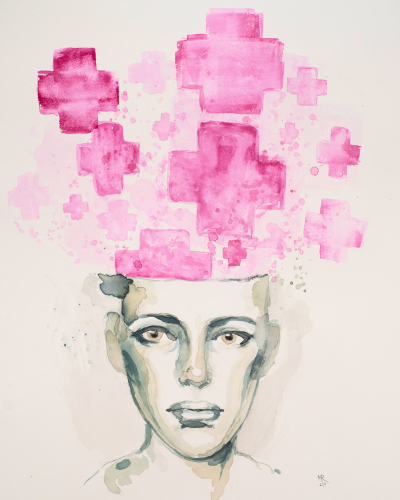
Illustration: Michael Riester.
And yet it never occurred to me to ask my husband to come along to hold my hand, and I’ve always said no when he’s asked if I need him there. Why? Part of me knows that I dislike being exposed, and if this essay makes you question that statement, perhaps I’ve made progress, though it is a different thing to share life shaped into art than it is to share a life.
Not every cancer story is a love story, and not every love story is a love story all of the time. Maybe I don’t ask him along because I don’t like how people defer to men when they’re around. Maybe I don’t like what happens to my decisions when they involve him, how he tugs my thoughts down paths I’d rather walk alone.
Maybe I’m angry because I wanted to take out the remaining fallopian tube during the occasion of my second birth. I knew a Caesarian delivery was a strong possibility, given my first baby (sunny side up, back labor for a full day, me vomiting constantly and no meds, my cervix refusing to dilate for the huge head ramming ramming ramming).
Once I was on the mend, I brought my husband with me to see my gyn/oncologist. They agreed that, unless we were absolutely sure we didn’t want more kids, it shouldn’t be done. I don’t want more children, I told them, unless there’s a disaster of some kind, and I needed to gestate a reason not to die of grief.
Let’s not make permanent decisions, said my husband.
I suspect him of wanting to see me pregnant again and again, though I don’t know why. I should have listened to my other ob/gyn, who told me that, given that unlikely occasion of a child death, I could always get pregnant via IVF, which bypasses the tube that serves as a nursery for most ovarian cancers. Many doctors no longer recommend removing the whole ovary, which is what they used to do, sending women into the desiccation of hormonal depletion decades before our time. Now, they watch and wait. Turns out, the female bits do real work for the body.
With their urging, I decided to keep my left tube, and the ovary. And now I will pay to find what they harbor.
Don’t think about it, said my husband. Your mind is powerful. It could be telling your body how to feel.
Don’t tell me what to do or how to think, I spat. It’s my body. I got this.
In Of Woman Born, a book about motherhood that took her two whole decades to approach, Adrienne Rich wrote, Women are controlled by lashing us to our bodies. Like me, she had a kind and supportive husband who understood her need to write. And though seventy years elapsed between her motherhood and mine, I found patterns that should not have startled me, but did:
Before my third child was born I decided to have no more children, to be sterilized…My husband, although he supported my decision, asked whether I was sure it would not leave me feeling ‘less feminine.’ In order to have the operation at all, I had to present a letter, counter-signed by my husband, assuring the committee of physicians who approved such operations that I had already produced three children, and stating my reasons for having no more. Since I had had rheumatoid arthritis for some years, I could give a reason acceptable to the male panel who sat on my case; my own judgment would not have been acceptable. When I awoke from the operation, twenty-four hours after my child’s birth, a young nurse looked at my chart and remarked coldly, ‘Had yourself spayed, did you?’
I go alone. Before dawn, I wake to silence my phone and leave the house to my husband and sons, so beautiful in repose. Relaxed, their faces are soft and round. One day they will sharpen and thicken into strong lines like his. I want to see them grow.
After the intern and her overseer reboot the ultrasound machine, I start my jokes routine. It gets me through hard times with strangers in front of whom I do not wish to cry. In the blood draw waiting area, my one sob (quiet though it was) sent a shimmer of response through the other people. What could I say to them, I who still had my hair? I who, a week ago, was worried about losing weight. Cancer! The diet you don’t plan!
Many things cause pain, and not all of them are cancer, says the supervisor before the wand goes in, or should I say, before I insert it, having requested the honor from the intern whose inch-to-the-left poke, I told them, Took me back to high school. They guffawed before they could lock it down, and I was pleased, despite the wand waving around inside me.
The intern is too inexperienced to remember that she shouldn’t answer my question — Don’t see a little baby hanging out where it shouldn’t be, do ya? — for an ectopic pregnancy would mean abortion or my death by hemorrhage. One or the other, and no in-between. Think about that, in times like ours.
Their faces grow somber in the pale light of the image I cannot see. The longer they look at the screen, the less they hold my eye, until, by the end, the supervisor speaks to the pillow behind my head, and the intern to her keyboard, their movements gaining speed, briskness, authority, as soon as the report is typed. I go to the bathroom so they don’t have to avoid me. Good luck with everything, the intern says when I leave, worry tinging her gaze.
Facing diagnoses that have not yet arrived, I command myself to appreciate what’s here. Existential anxiety can be eclipsed. For a moment you see death dancing like a corona of solar winds, visible now that the moon has blocked the sun. The curve of the horizon turns gray and ghostly, all hues sapped from the sky except for the deep night of space. The birds quiet down. Flowers close against the cold, which you can feel in your body, knowing as if for the first time that we are part of a celestial order that cares not for our worries. Seen from outside the path of totality, the shattering prospect of a diagnosis is scattershot, a halo of leaves dappling the ground with estranged outlines. But within that path, the darkness is total.
These moments — like the one we are living, when women have to cross states and picket lines to access the care we need — thin the veil. For a second, we see through them to what is ahead. Even when we’re spared, we’ve seen it. We can’t pretend it’s not there.
Yet there always has been, and there remains, intense fear of the suggestion that women shall have the final say as to how our bodies are to be used, Rich wrote. It is as if the suffering of the mother, the primary identification of woman as the mother—were so necessary to the grounding of human society that the mitigation, or removal, of that suffering, that identification, must be fought at every level, including the level of refusing to question it at all.
I write hard because I want to build a body of work before it’s too late. Again and again, I defer gratification for future gain. I know I won’t be paid for these hours. It comes back to time. I may not have much. Facing tumors, facing toddlers, facing essays, facing my yearning to write more books, facing my desire to spend time with my kids my husband my friends my books my writing my own mind my own self feeding and caring for my own body, facing all of it, I want to live to the fullest extent of my imperfect freedom, and I intend to do just that.
Kristen Millares Young is a journalist, essayist, and author. Her novel Subduction was a winner of the Nautilus and IPPY awards, as well as a finalist for two International Latino Book Awards and Foreword Indies Book of the Year. She is also the editor of Seismic. Millares Young was the researcher for the New York Times team behind “Snow Fall,” which won a Pulitzer. Her essays, reviews, and investigations appear in the Washington Post, The Guardian, and anthologies such as Alone Together.
Kristen is currently giving a talk, How to Write a Family Portrait / Cómo escribir un retrato familiar, throughout the state. Find an event online or near you.