
Consider the Oyster
From a vital food for Indigenous cultures to an economic engine, Washington’s history is inseparable from a tale of two oysters.
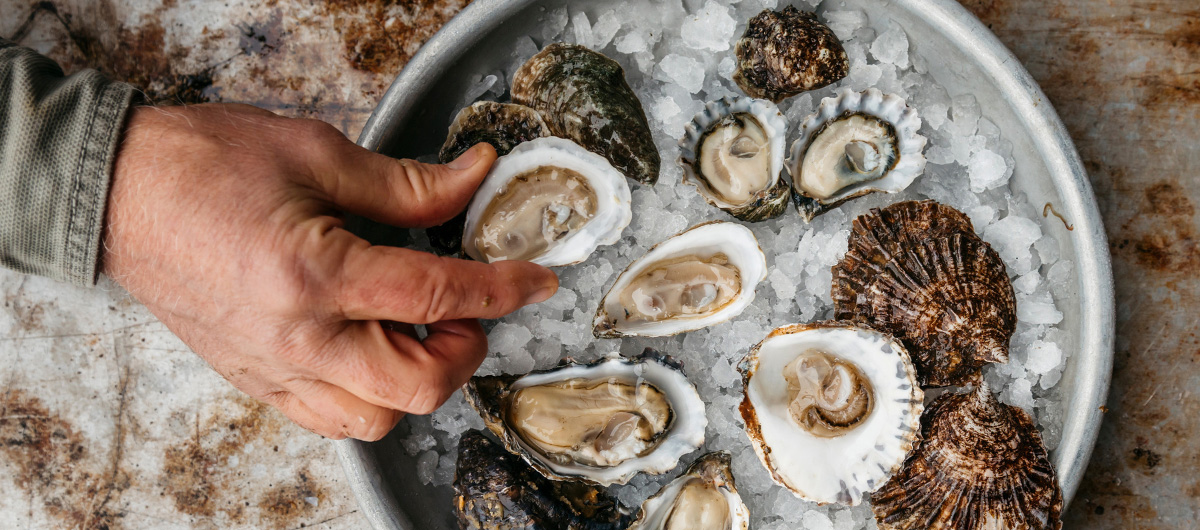
The oyster farmer spends the best years of their life in the service of a cold-blooded animal with a calcium shell.
Clad in rubber rain gear and thick-soled boots, oyster growers spend hours on blustery beaches, constructing beds in which young oysters will slumber and the grown-ups will reproduce. They stand watch, night and day, to defend the occupants of those beds from predators. They do everything possible to protect the oysters from pollution, disease, and the occasional oyster pirate—the midnight marauder who helps himself to shellfish in someone else’s beds.
If all goes as planned, an oyster farmer’s beds will thrive, and the oysters in them will grow plump and ripe. In a few years, the oysters will reward the hardworking grower with their meat. The monetary gains from selling oysters are usually modest. But a few fortunes have been made on such dealings. A few more have been lost . . . and won again. That’s the nature of the oyster business.
Making money is just one reason folks in the Pacific Northwest farm oysters. What, then, draws oyster farmers to the water’s edge at dawn or in the dead of night? What makes them work so hard, often in miserable weather, to keep their oysters fat and fit? What makes the rest of us clamor for that small tidbit of flesh, cradled by the smooth inner nacre of an oyster’s thickly sculpted shell? One answer is obvious: the ambrosial tastes of the Northwest oyster, a flavor unsurpassed by any other of the world’s edible shellfish.
The story of this transcendent flavor is largely a tale of two oysters: the native Olympia and the non-native Pacific, and the hardy growers who tend them. But the native, once abundant, now makes up a lowly 2% of the oysters farmed in the Pacific Northwest. The reason for its decline touches on issues of cultural identity, ecological stewardship, and belonging.
***
From the earliest of times, oysters have been prized by the Indigenous peoples of the Pacific Northwest. “Before the arrival of European settlers, our tribe was known throughout the Northwest for its highly productive beaches,” says Charlene Krise, executive director of the Squaxin Island Museum Library and Research Center. “Mile for mile, we had the richest shellfish beaches of anywhere around.”
The earliest physical evidence of shellfish mariculture in North America dates back to about 1480 BCE, with evidence from shellfish middens showing the likelihood of shellfish cultivation and sustainable harvest techniques dating as far back as 11,500 years ago. In what are known today as “clam gardens” and “sea gardens,” Indigenous peoples built rock walls in the intertidal zone to foster favorable habitat for shellfish. Krise says her Coast Salish ancestors also constructed oyster dikes made of cedar planks and old canoes. The dikes retained seawater and regulated the flow of nutrients essential to the clams’ and oysters’ reproduction and growth. The oysters, later to be named Olympia oysters, were collected and carried, along with other bivalves, in durable baskets woven of cedar limbs and roots cut into strips. The weave of these receptacles was open, allowing seawater to circulate freely when the baskets were immersed in the tides. This way, the shellfish could be purged of any sand or grit.
The oysters they were collecting were the Olympia (Ostrea lurida), and it is the Northwest’s only native oyster species. Its small size (typically less than three inches across) makes this animal easily distinguished from its non-native kin. Naturalist William Cooper, who traversed the Washington Territory with a team of railroad surveyors in the 1850s, found them to “possess the same peculiar coppery flavor remarked in the European mollusk when eaten for the first time.”
Shoalwater Bay in southwest Washington was a natural haven for the Olympia oyster. For many generations the Lower Chinook, Lower Chehalis, and Willapa people sustained themselves on Shoalwater Bay’s bounteous shellfish, salmon, shorebird, seabird, and cedar tree resources.
Their lives changed dramatically with the appearance of the first European fur traders and the epidemic diseases they carried. By 1852, when James Gilchrist Swan compiled the notes for his now classic personal chronicle, Three Years at Shoal-Water Bay, Swan estimated that there were little over one hundred Chinook people—a tenth of the estimated peak population in precontact times.
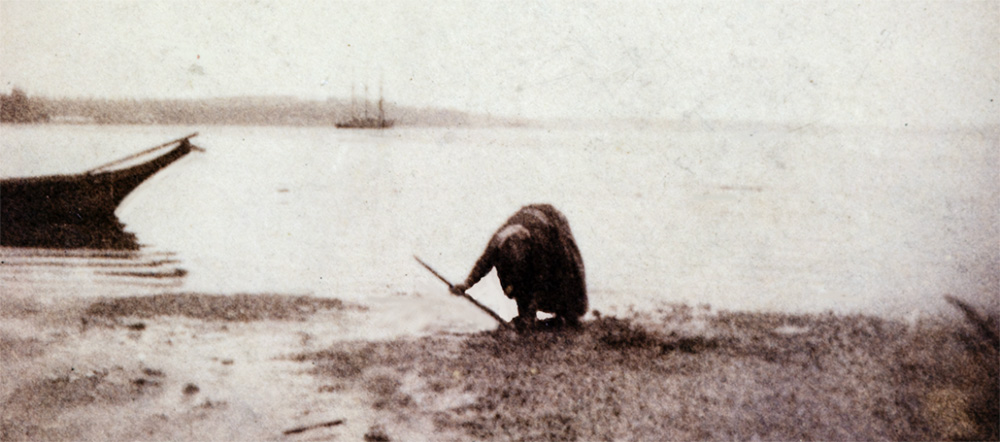
Native American woman harvests shellfish in Mud Bay, WA. Taken in 1905, using a first-generation Kodak camera. Photo courtesy of the Alaska State Archives, Office of the Governor, Judge James Wickersham.
At the same time, the Chinook and Chehalis people remained a political force. In 1855, Washington territorial governor Isaac Stevens proposed a treaty in which multiple tribes in the region—including the Chinook and Upper and Lower Chehalis—would relocate to a reservation in the Quinault Indian Nation’s territory. The Native Americans living at Shoalwater Bay refused. In 1866, descendants of Chinook, Lower Chehalis, and Willapa people formed the Shoalwater Bay Tribe through President Andrew Johnson’s executive order that set aside a 355-acre piece of land for them. (By comparison, through the Homestead Act of 1862, the United States granted a married couple of US citizens the right to claim 320 acres.) “This reservation was set aside with the intent that these last holdouts would have their own reserved land for fishing, shellfish harvesting, and hunting,” the Shoalwater Bay Tribe explains on their website. “This part of Willapa Bay has sustained our ancestors since the beginning. It continues to sustain our people and enables us to reach out to the greater community.”
The early white settlers were drawn to the unbelievable natural abundance of Shoalwater’s shores. Captain Charles J. W. Russell was among them. In 1850 he built the first European-style house in the region, from which he ran a trading post—an indispensable outlet for his fellow pioneers, most of whom lived in lean-tos of rough-hewn timber roofed with sailcloth. Russell lived near Chief Toke, a leader of the local Chinook and Chehalis people, and began to employ many of his Indigenous neighbors in gathering oysters.
In 1851, Russell traveled to San Francisco, where he introduced the first sacks of Shoalwater’s Olympia oysters to the city’s shellfish merchants. San Francisco had gone from a tiny hamlet to a major metropolis of 30,000 people seemingly overnight thanks to the Gold Rush. The oyster was a symbol of wealth and status in the city, and demand was huge. However, overharvesting and poor management had left the city’s oysters in desperately short supply. Russell was happy to flood the city with Northwest oysters, and in the process, launched one of the more lucrative ventures of the nineteenth-century Northwest.
***
Russell’s sacks represented the tip of an oyster iceberg. Over the years a virtual flotilla of schooners arrived at Shoalwater Bay, brought aboard bushels of wild-harvested oysters, and then made haste for San Francisco, where jubilant diners awaited. The Pacific Northwest oyster industry exploded. At one point the town of Oysterville on Long Beach peninsula possessed more gold per capita than any other town or city along the Pacific coast, with the sole exception of San Francisco. According to local lore, the nearest bank was in Astoria, Oregon, so much of the gold was either lost in transit or buried in the sand around Oysterville. Despite numerous treasure hunters’ attempts, no such wealth has ever been recovered.
After the collapse of their oyster industry, California needed a way to compete with the Northwest’s abundant beds. They found it in the Eastern oyster (Crassostrea virginica), which they began importing from the East Coast. After a rocky start, the industry grew exponentially. The popularity of the Eastern oyster caused the price of Northwest oysters—now called “Olympias”—to collapse, and Washington’s oyster farm owners found themselves in dire financial straits. By the mid-1870s the price of “Olys” had dipped to a mere four dollars a sack. Ten years later, the same sack fetched $2.50—about half the price paid for the esteemed Easterns. The once-lucrative Olympia oyster industry was now as lifeless as a sun-bleached oyster shell.
****
To save itself, Washington’s oyster industry looked east as well. After years of waiting for the transcontinental railroad to allow Eastern oysters to be imported to the Northwest (San Francisco had the advantage of connecting to the railroad decades before), the first batches of Eastern oysters arrived in the Northwest in the late 1800s.
Rearing Eastern oysters in Washington turned out to be a cinch—or so it seemed. One only needed to buy baby oysters from afar, plant them, and wait for the comestibles to come of age. Within a decade, the Washington business in Eastern oysters had burgeoned into an enterprise valued at around $1 million and employing several hundred individuals. Production figures steadily climbed from about four thousand gallons of meat in 1902 to twenty thousand gallons in 1908.
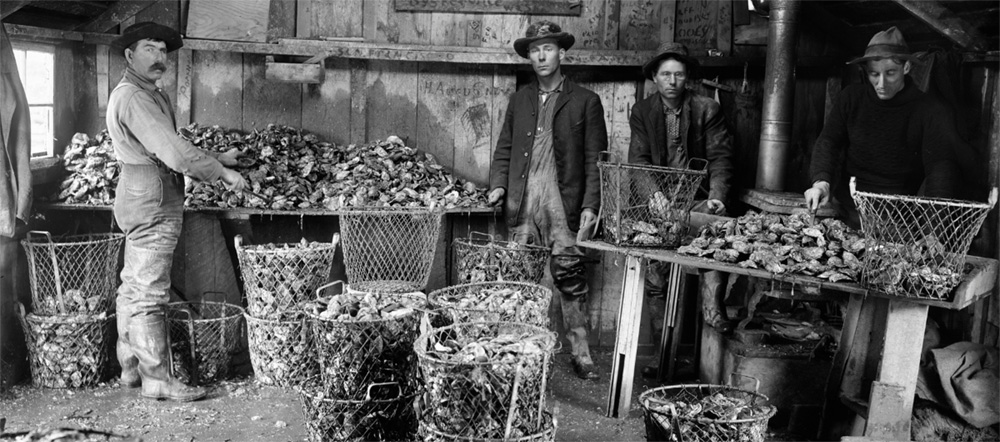
Northwest shucking houses were hubs of activity in the 1800s. Carved into the back wall of this Oregon facility are the words “Oysterville” and “San Francisco,” plus the initials of shuckers who worked at this place. Photo courtesy of Oregon Historical Society, Gi 7203.
Along with Eastern oyster culture came an existence inspired in large part by life on the Atlantic coast. The shift from a purely extractive industry, one where Olympia oysters were simply plucked from their natural habitats, to one of planting and harvesting from well-tended beds, required oyster workers to keep in closer proximity to their intertidal and subtidal holdings. Growers built one- and two-story homes on pilings, clustering what were known as “station houses” near the most productive beds. As many as five or six workmen lived in a station at one time.
Some station house residents spent weeks, months, and, in the case of oysterman Richard Murakami, entire years in these outposts. “I was born there [in 1914],” Murakami told an interviewer from the Washington State Oral History Program. “We didn’t move to land ’til I was about five years old.”
***
But in 1919, just a couple decades later, the Northwest’s new venture into farmed oysters suffered a collapse. For some reason, quite possibly related to tides and water temperatures, the expense of harvesting oysters, or a combination of all three, the Northwest’s stocks of Eastern oysters were not reproducing. Harvest and recruitment rates had been nowhere near commensurate.
When a more cost-effective alternative presented itself, Northwest growers leapt at the chance to abandon the Eastern oyster trade altogether. In northern Puget Sound they were hard at work, readying their beds for another imported shellfish, the Pacific oyster (Crassostrea gigas). Hale and hearty, this species had been successfully cultured under similar oceanic and weather conditions for several centuries in Japan. Still, there was reason to believe this foreign marvel might not thrive and multiply in North American seas.
Two entrepreneurs stood ready to accept the challenge. J. Emi Tsukimoto and Joe Miyagi were residents of Olympia, Washington, yet had family ties that extended across the Pacific to the suppliers of Japan’s superior oyster stocks. Both men possessed experience in the shellfish industry, having worked in the shucking house and shellfish beds of the J. J. Brenner Oyster Company.
Tsukimoto and Miyagi had staked out six hundred acres of tideland on Samish Bay, south of Bellingham. With its remaining money, their company—Pearl Oyster Company—bought four hundred cases of Pacific oysters, grown in the Miyagi Prefecture and shipped in early April 1919 from the port of Yokohama in northern Japan. These fine specimens were loaded onto the deck of an American steamship, the President McKinley, covered with a protective layer of Japanese matting and given frequent showers of seawater to keep them fresh throughout the voyage. The well-tended cargo—approximately eight hundred bushels of high-quality shellfish stock—arrived in Seattle eighteen days later. But Pearl Oyster’s people were in for a shock. Many of the larger oysters were dead on arrival. The rest were hastily transplanted to the company’s beds, in the off chance of resuscitation. Any hopes of salvation were soon dashed, however, as these sole survivors slowly perished.
At one point the town of Oysterville on Long Beach peninsula possessed more gold per capita than any other town or city along the Pacific coast, with the sole exception of San Francisco.
As it turned out, however, the experience was not a total loss for Pearl Oyster. Attached to the shells of the recently expired were hundreds of fingernail-sized spat—juvenile oysters that had apparently settled on their parents’ calcareous crags in Japan. Like the mythological phoenix rising from the ashes, these youngsters would eventually grow to adulthood and become the first cash crop of Pacific oysters ever cultivated in the New World.
After two years in the plankton-rich waters of northern Puget Sound, Washington’s Japanese transplants had grown from near-microscopic spat to adult specimens with shells over six inches in length. By one calculation at the time, it would take only 120 of these mega-mollusks to yield a gallon of shucked meat—a twenty-fifth of the Olympia oysters required to produce the same quantity.
The state’s production of oyster meat nearly quintupled in just two years—from 6,500 gallons in 1929 to 31,000 gallons in 1931. But not everyone in the Northwest was as appreciative of the new oyster species as the growers would’ve liked. Pacific oyster grower E. N. Steele found some consumers were reluctant to try something new. As he made the rounds of Seattle-area restaurants and fish markets, he found that each owner had initial objections and, as he put it, “had to be shown that their business would be increased by making the change” from imported Easterns to locally grown Pacific oysters.
Some buyers felt the Pacific oyster’s characteristically dark-rimmed flesh made it appear unappetizing. Steele overcame this prejudice with a snappy advertising campaign. “Look for the oysters with the velvet rim,” his printed advertisements proclaimed. “It assures you that it is grown in the pure waters of Puget Sound.”
Others were unaccustomed to the new oyster’s large size. Steele won over these skeptics with cooking demonstrations, staged by his brother and sister-in-law with a three-burner electric hot plate. Shoppers were offered fried oysters and shown how to make what Steele called a cracker sandwich. “Many of those who liked the sample would purchase a can of oysters, and were assured that this market would keep a supply for future use,” he wrote.
Steele’s persuasive presentations and promotional materials worked remarkably well. In one day, workers at the Portland Fish Market sold eighty dollars’ worth of Pacific oysters, at thirty-five cents for a half-pint and sixty-five cents for a pint. Buoyed with optimism, Steel bought a small Dodge truck, fitted it with sleeping quarters for his sales staff, and packed it with advertising materials and painted oyster shells. This oysters-on-wheels operation spread the word about Pacific oysters as far south as San Bernardino, California, and as far east as Salt Lake City.
Other oyster growers followed, literally, in Steele’s salesmen’s footsteps. With massive quantities of Pacific oysters to sell, Willapa’s growers soon dominated the market, unintentionally driving down oyster prices with their surpluses. Although smaller-scale operations such as Steele’s suffered, there was enough business in oysters for everyone to benefit to a degree. No longer viewed with suspicion, the immigrant oyster was now regarded as a “naturalized” citizen of Northwest shores, one with a solid reputation for conferring wealth on its cultivators. Output skyrocketed over the next ten years, reaching a record 1,131,100 gallons in 1941.
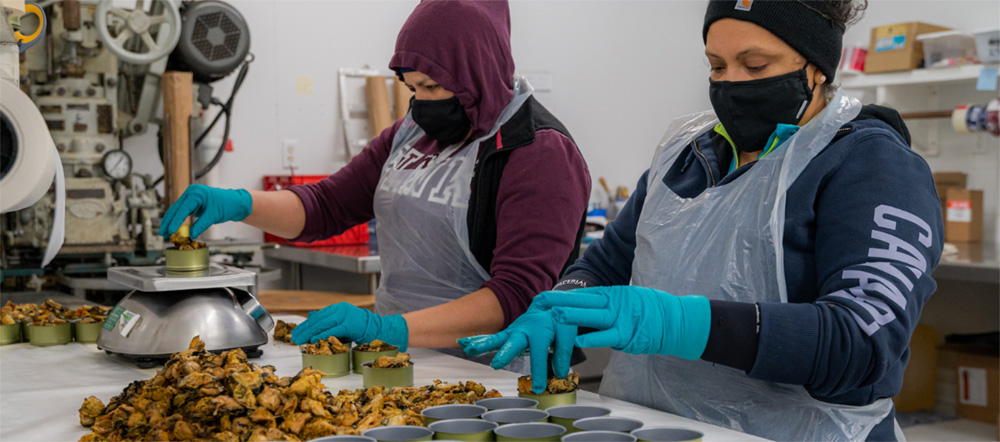
Employees of Taylor Shellfish Farms sorting oysters. Photo courtesy of Taylor Shellfish Farms.
Roughly five times the size of its distant cousin, the Eastern oyster, the Pacific oyster is the giant of Northwest shellfish beds. Just like a runaway zucchini in a vegetable patch, overlooked Pacifics can grow to lengths of ten inches or more over a period of about ten to fifteen years. These biggies are known as “tennis-shoe” oysters in the trade, because of their resemblance to flat-soled footwear.
Pacifics are also one of the fastest-growing species, reaching sexual maturity in a year. In addition, it is better adapted than either of its distant relatives to enduring cold spells and other caprices of coastal weather. For all these reasons, the Pacific is one of the most intensively farmed oyster species in the world.
***
The modern-day Northwest oyster has landed in a curious position: 98 percent of them are Pacifics—a species that believers in pristine wilderness could rightly argue doesn’t belong in Northwest waters due to its non-native status.
And yet many environmental advocates have often pointed to the Pacific oysters’ beneficial presence in the region. After all, oysters are heralded for their ability to filter our water, make habitat for other species, and provide one of the least environmentally impactful sources of protein that humans produce. Given that access to native Olympia oysters is now limited, Pacifics offer an alternative to an economically and culturally important food. By now, generations of shellfish growers have staked out both their livelihoods and their lifestyles through cultivating Pacifics. Through these generations, shellfish growers have been pivotal players in many efforts that have helped maintain or improve the local water.
After decades of neglect, though, Olympia oysters are again drawing the attention of shellfishers in the Pacific Northwest. Most of this interest, though, is not food-related. Instead, it’s focused on the little oysters’ big role as what is known as a keystone species—an organism on which many other species depend. The nooks and crannies created by the smaller, more densely packed clusters of Olympia oyster shells provide safe havens and sites of attachment for tiny, niche-dwelling marine fish, invertebrates, and plants. Studies suggest that Olympia oysters support richer and more diverse underwater communities than do similar-sized clusters of farmed Pacific oysters. Members of these communities often include the prey of larger marine animals—from hefty Pacific salmon to gargantuan humpback whales.
Looking ahead, restoring Olympia oysters could also foster greater ecological resilience: research led by George Waldbusser of Oregon State University suggests that native Olympia oyster larvae may be less vulnerable to acidified seawater than their cousins originally from Japan. “It’s good to have some hope and optimism around marine organisms, because there’s so much bad news,” says Waldbusser.
Add cultural significance to the list of reasons for favoring native Olympia oysters over non-native Pacifics. Tribes in California, Oregon, Washington, British Columbia, and Alaska harvested Olympia oysters for thousands of years before other species were introduced to the Northwest.
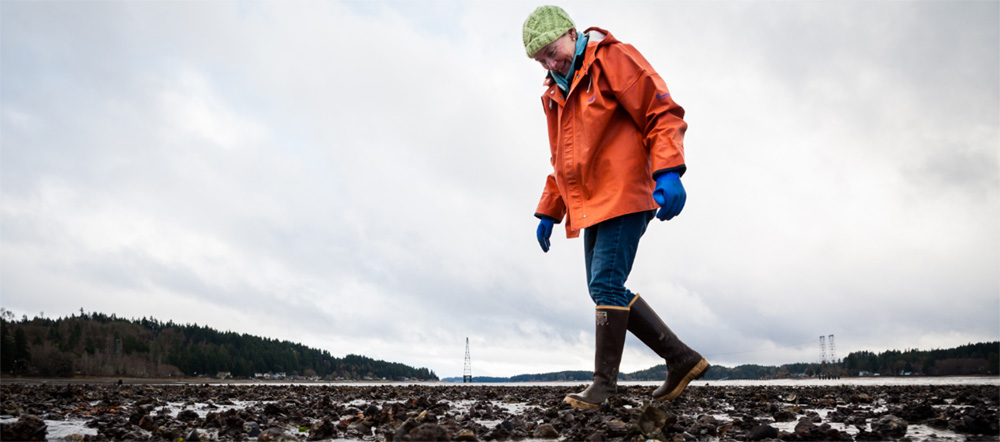
Betsy Peabody, director of Puget Sound Restoration Fund, surveys a restoration site for native Olympia oysters, 2019. Photo by Benjamin Drummond for Puget Sound Restoration Fund.
Returning Olympia oysters to their historical habitats is “a very powerful thing to do,” according to Genny Rogers of the Skokomish Indian Tribe, the original inhabitants of Hood Canal, Washington. “It’s part of our identity, our world,” she says.
Around the turn of the millennium, workers with the Washington Department of Fish and Wildlife joined forces with the nonprofit Puget Sound Restoration Fund, the for-profit Taylor Shellfish Farms, and the Skokomish, Squaxin Island, and Suquamish Indian Tribes to put Olympia oysters on the very same beaches where these small wonders once abounded. Many other tribes, growers, and other partners have joined the effort since. In 2010 these groups rallied around the ambitious goal of restoring 100 acres of Olympia oyster beds in Puget Sound over the next decade. At the time there were fewer than 150 acres of natural Olympia oyster aggregations.
The groups identified more than a dozen distinct sites where they would carry out their efforts, and had a lot of success. The team’s restoration work in Dogfish Bay, for example, grew the population from a few hundred to more than six million.
“The thing no one could possibly have anticipated, not even myself, was the devotion that so many people felt to this oyster,” Peabody says. “Olympia oysters are woven into the history and ecology of this place in many ways. They have been, since the beginning, a gift that keeps on giving—as a First Food, as the oyster that launched our state’s shellfish industry, and as an ecological superstar. They belong in these waters still. I think it was this shared love of Olympia oysters that floated the recovery effort, as we each sought to tether ourselves to something good and meaningful and resilient in the watery world around us.”
DAVID GEORGE GORDON is the author of twenty-two books on topics ranging from slugs and snails to sharks and gray whales. He served as Washington Sea Grant’s science writer from 1998 to 2012.
SAMANTHA LARSON has been the science writer at Washington Sea Grant since 2017. Her writing and reporting on science, the environment, and adventure has also appeared in dozens of publications, including National Geographic, Grist, and High Country News.
MARYANN BARRON WAGNER has worked in communications since 2000 and served as assistant director for communications at Washington Sea Grant since 2014. Born and raised in the Pacific Northwest, she has an appreciation for all bivalves, great and small.
This article was adapted from the book Heaven on the Half Shell: The Story of the Oyster in the Pacific Northwest, published by University of Washington Press.
David George Gordon is currently giving a talk on Washington State oyster history as part of Humanities Washington’s Speakers Bureau. Find an event.