
In Defense of Dabbling
Is it better to be great at one thing—or pretty good at a lot?

I ran into AnnMarie on a warm, June afternoon as I was wrestling down my farmer’s market tent. This was the first year our farm made and sold sheep’s milk cheese, and after a long morning caring for my two young daughters and working in the creamery, I was going home after four hours at the market. To say I was exhausted would be an understatement.
AnnMarie was leaving after picking up some of her work from a pottery cooperative stand. We had met years earlier at an art workshop on Guemes Island, during a time in my life when I had time to take art workshops. Now, seeing what she had in her hands, I commented on how much I loved her style, her brightly colored serving dishes decorated in original images. AnnMarie smiled and handed me a beautiful white bowl painted with green-colored leaves.
“Here, take it!” she said.
In return, I offered her some of the cheese I had left over.
“Next time,” she replied. “I am about to head out on the boat for two months!”
In addition to teaching high school ceramics, AnnMarie was also a fisherwoman, operating a 106-foot fish tender in Alaska with her husband, Mack, during summer break from school. When I got home, I placed the bowl on my kitchen counter and admired the unique shape, design, and craftsmanship, that clearly made it a piece by AnnMarie.
At one point, I was so bold as to call myself a potter like AnnMarie. It is one of many titles—like writer, scientist, or farmer—I have given myself over the years. My creative urges have followed many paths that range from throwing pots, watercolor painting, printmaking, songwriting, and I will even include cheesemaking on this list. My admiration for AnnMarie’s work came from a shared appreciation of good food—this bowl would be perfect for a cucumber salad or a heaping side of potatoes—and past experience dabbling in various artforms.
A critic might say I am a jack of all trades, master of none. A fan might call me a renaissance woman. Admittedly, I am undecided as to whether having multiple, sometimes disparate, interests is a boon or a bother. History has a long list of notable dabblers who had many public and private interests, such as Plato and Leonardo DaVinci, Charles Darwin, and Emily Dickinson, who were applauded for their respective abilities to traverse and bridge multiple disciplines.
I remember when basketball legend Michael Jordan enraged the world by announcing he was leaving the Chicago Bulls prematurely to try professional baseball for the White Sox. It was around the time I started playing high school basketball (I can add “athlete” to my list of titles) and although I was loyal to the Seattle Supersonics, I loved the Chicago Bulls. In making this decision, Jordan had crossed some imaginary, sacred line in the sand and people did not have space in their minds or hearts for Jordan, the shooting guard, as well as Jordan, the outfielder, regardless of his all-around athleticism. While his baseball career only lasted a year and he did return to basketball for a few more championship wins, I’ve admired his boldness, his willingness to embrace a new passion.
I am not claiming to be the Michael Jordan of anything, but I sometimes feel plagued by my various interests and what to do about them. As much as I have tried to focus on one thing, new interests always tend to find their way in. Career-wise, I loved learning about the environment, so I studied biology in school. Later, I discovered that I preferred writing poems as a way of observing and working with nature. Instead of crafting experiments as an agricultural researcher, I started my own farm and learned to make value-added products, like cheese. All along, I have loved visual arts, but haven’t had the means (or maybe confidence) to focus on those inklings in any meaningful way. In my mind, my interests are a unique expression of me and therefore in conversation with each other. Creativity feeds creativity. However, we live in an era where specialization is paramount. The educational lens grows more and more narrow with time and the canyon between STEM (science, technology, engineering, and math) and humanities curricula runs wide and deep.
The term multipotentiality is defined by Emilie Wapnick, author of How to Be Everything, as “a psychological and educational term used to describe people who display aptitudes across multiple disciplines.” As someone who has always felt most at home in interdisciplinary settings and fairly claustrophobic in the siloed landscape of higher education in general, I find this term validating. Instead of thinking of multiple interests as a distraction, there is solid evidence to show that some people are wired to have an affinity for many different things.
***
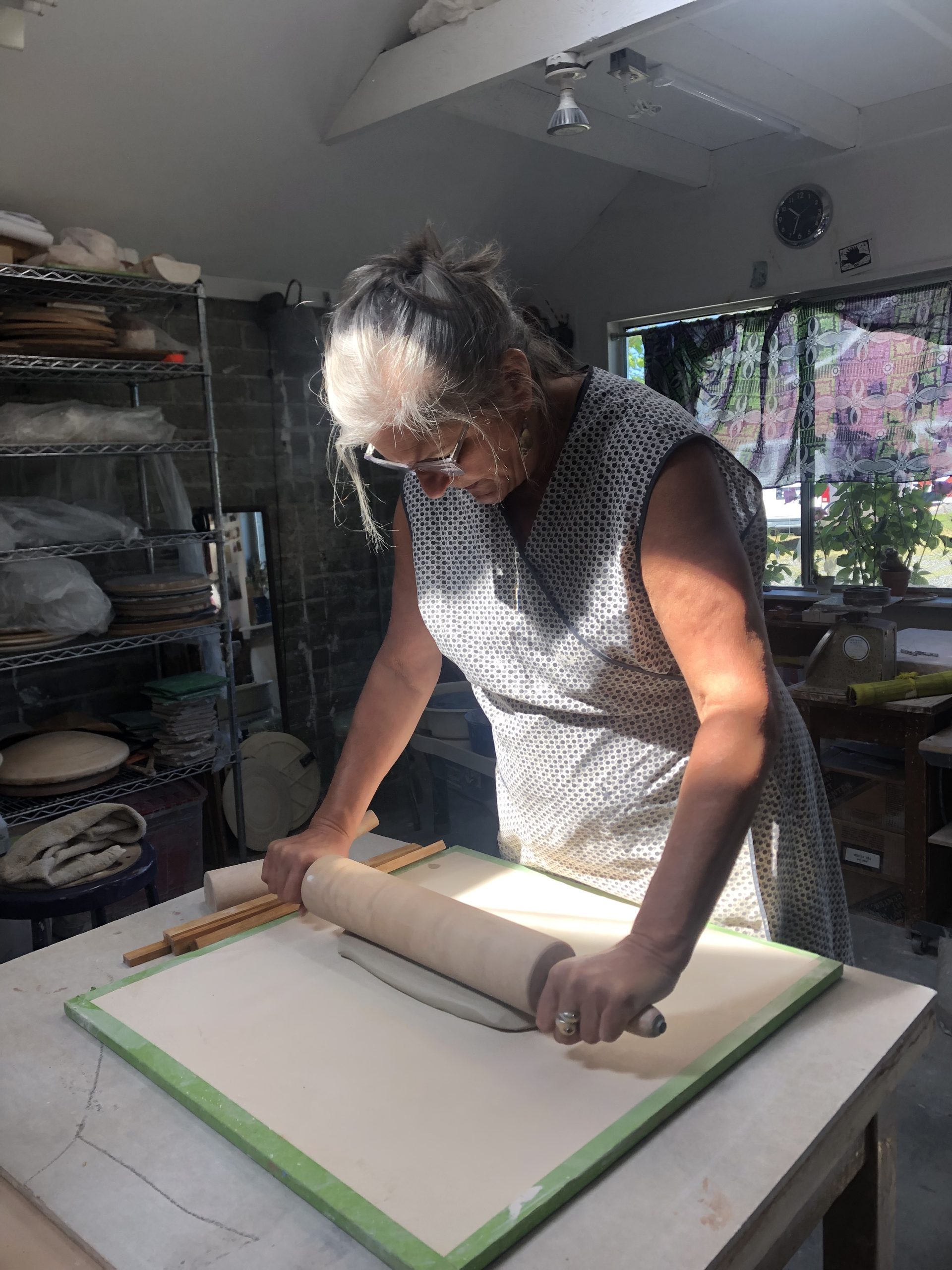
AnnMarie at work. Photo: Violeta Martin.
Four years after receiving that bowl from AnnMarie, I reached out to see if she was offering any classes. She had recently retired from teaching. AnnMarie and Mack were in the process of selling their fish tender to their son. When she suggested I start with hand-built cheese plates, a light bulb went off. I remembered the work of Belgian artist Bernard Palissy, from the sixteenth century, who carried had an extensive list of titles (scientist, land-surveyor, religious reformer, garden designer, glassblower, painter, chemist, geologist, philosopher, and writer), according to the Getty Museum. His platters, with their intricate relief work and surprising nature imagery, have stuck with me. I quickly saw how I could make something similar using my own images and Ann Marie’s surface design technique.
When I moved onto the farm and had some extra space, I serendipitously found some used ceramics equipment. Someone from a nearby town posted on Craigslist that he was giving up his ceramics hobby to focus on woodworking and whoever bought the kiln could take every piece of equipment in his studio as well, which included a pottery wheel, lots of hand tools and glazes, and a sturdy worktable. Since high school, I have taken the occasional ceramics class with a variety of teachers, mostly men. I borrowed a friend’s truck and jumped on this great deal. However, that pile of supplies and equipment has sat idle in my barn for over a decade. The demands of the farm and, eventually appending the title of ‘mother’ to my list, made it hard to carve out space for art.
Time is, undoubtedly, an important topic in the conversation of multipotentiality. The predominant rule is that it takes ten thousand hours of doing something to become an expert. Interestingly, psychologists have debunked this theory of practice (made popular by Malcolm Gladwell) adding that while repetition is important, the quality of teaching matters just as much, if not more. Humans are awake on average of sixteen to eighteen hours today, and if we factor in the average lifespan (78 years), that leaves a lot of hours to learn new skills. While other important life things like eating, exercising, parenting, and working might take up the lion’s share of these waking hours, there should be some idle time left over? In theory, yes, but it’s complicated.
Admittingly, I confess that I have driven myself to various states of burnout in my adult life by taking on too much at once. It is a natural inclination for me that is maybe a mix of nature and nurture. However, I have learned that creativity is not linear, and I want to believe that in our lifetimes there are ample opportunities to spiral back around to hobbies and talents during various chapters, as time and fund allow.
When I get the comment, “Oh you do so much!” I know it is a compliment laced with a little confusion, envy, and disbelief. I don’t think I am phenomenally more productive. However, I have developed a seasonal lifestyle with farm work occupying my spring and summer months and writing and teaching being the focus of the fall and winter months. The transitions are never seamless, but I do get the chance to circle back to projects and make slow progress over time without getting too bored or overworked in one area of my life.
Repetition can be hard for the dabbler, but it is a core part of learning a new skill. Finding that sweet spot of talent, enthusiasm, and discipline is the true art of holding multiple interests.
After Ann Marie and I received the Heritage Arts Apprenticeship Program (HAAP) grant in August of 2024, we set up a weekly meeting time in her studio in Ferndale with the goal of eventually getting my barn space functional for making ceramics.
The urge to make things has always been innate for AnnMarie. A descendent of Italian immigrants, she says her relatives came to the new world with skills that ranged from marble cutting to lacemaking to plumbing. AnnMarie had started making ceramics at a community college in Alaska, going on to teach ceramics in Ferndale and Bellingham for thirty years. When she moved to her current property, a small farm in rural Whatcom county, the first thing she did was create a studio space in one of the farm’s old outbuildings. Even while on the boat she brought along ceramic supplies, draping freshly rolled slabs over countertops in the fish cut room. Multipotentiality is something AnnMarie understands.
Working in an apprenticeship model, versus a classroom, is illuminating and intimate, with ample room for growth and self-reflection. AnnMarie says a lot of her experience with high schoolers was about, “grabbing their attention and having them become engaged in an activity that they conquer. They can prove their skills, do a task, do it well, and then learn how to clean up their tools and write about it.” Our relationship is different than the typical student-teacher model and we have formed a unique connection that interweaves mentorship, friendship, a love of food (she feeds me every time I visit her), and a shared community of northwest-based artists (mostly female) that range in age from thirties to sixties. It is important to note here that another perk of having multiple interests is the connections formed with new and different people that share those interests.
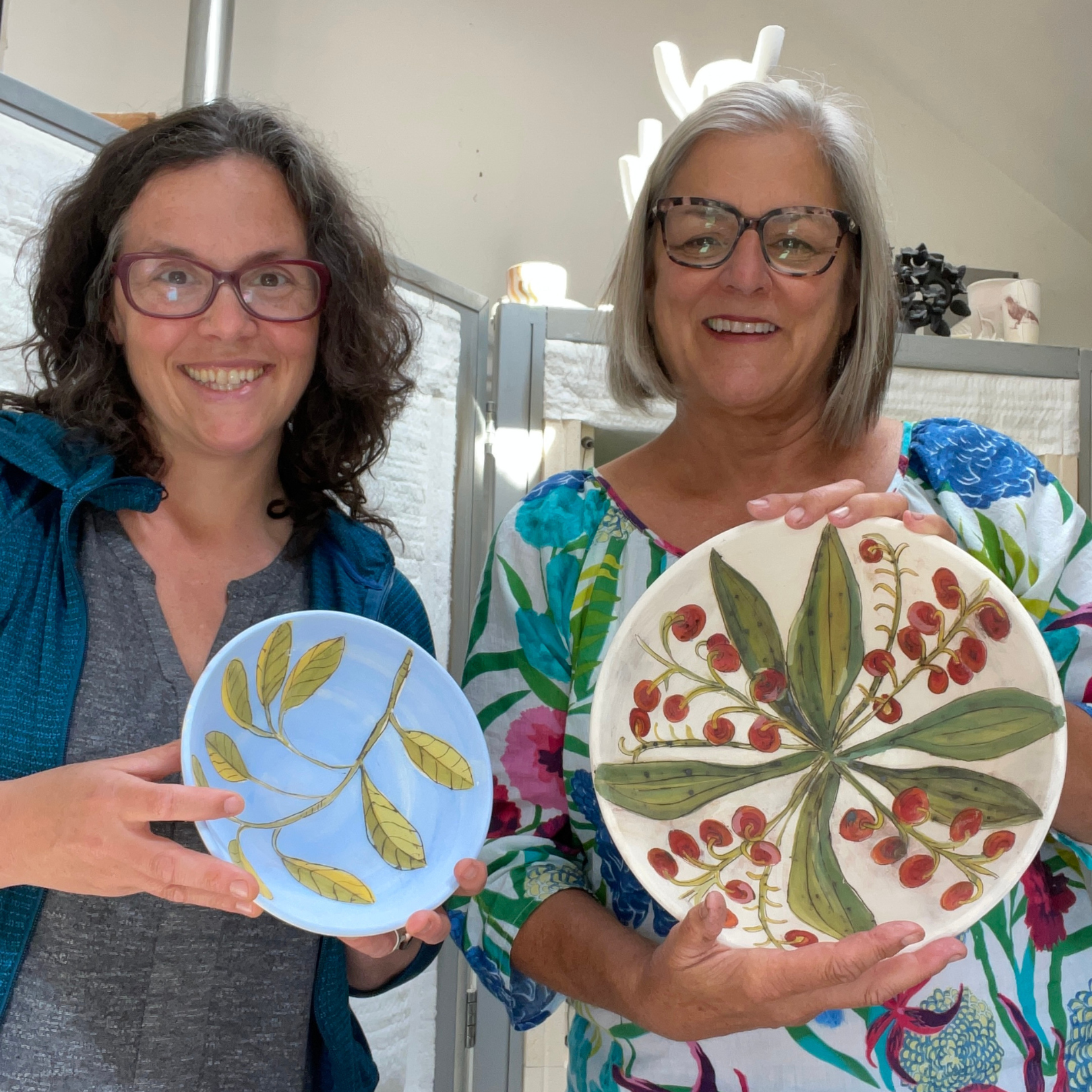
The author with AnnMarie. Photo: Violeta Martin
Since we are both mothers, many of our studio conversations veer into the realm of artmaking and motherhood—how do you stay connected to your creativity amidst all the other responsibilities? The answers are not simple and for someone like me with multiple interests, the juggling act becomes even more precarious. AnnMarie has taught me the importance of my studio being “a separate place” apart from my regular life. Reflecting on her teaching days with young children, she says, “I didn’t get to go to the studio until nine at night and I worked out there from nine to eleven, then I would wash up and go to bed, and get up at five fifteen. It was stupid. I was exhausted all the time, but I really wanted to do it.”
With such a tactile medium, like clay, you can’t leave works for large swathes of time. It is not like an essay idea, which can deepen over time. My platters will literally dry up, crack, and warp, if I forget about them. Dedicating that continuous attention is hard, and I know that if I had more hours to care for my platters and bowls they would be better. (Most of those hours are going to sheep and children right now). When I can string together my attention I end up with something unique and elegant, like a pearl necklace. However, my often haphazard approach to art-making leaves me with a tangled knot of ideas that are hard to execute, produce sloppy work, or don’t ever quite come to fruition. Repetition can be hard for the dabbler, but it is a core part of learning a new skill. Finding that sweet spot of talent, enthusiasm, and discipline is the true art of holding multiple interests.
***
Ceramics hovers between craft and art. For me, ceramics will probably stay in the realm of a hobby, whereas AnnMarie is trained as a fine artist and I am ok with that. She has had a lot of success selling her work out of her studio and at galleries in Washington and Alaska. It is possible I will have wares to sell in the future, but right now I want to be competent in this form and also appreciate the process itself. Clay is for play for me whereas I hold my writing life to a much higher standard. Being clear on my intentions is what makes dabbling defensible for me.
Our HAAP grant ended in June, but I also now have someone to call when I have pottery-related questions or am feeling guilty about spending time with clay versus tackling my many other to-do lists. I have a mentor who understands my multiple interests. While my one hundred hours in HAAP pales in comparison to the ten thousand hours needed for mastery, this year spent reviving my interest in clay has enlivened parts of my brain. And, after taking time away for ceramics, I come back to my other work—writing, farming, and teaching—with a renewed sense of purpose and vigor. Multipotentiality begets vitality.
Every so often I let my daughters, who are now seven and nine, come out to my studio. It is exciting to see where their wild imaginations take them. The tactile experience of cool clay on their little hands draws them in and within minutes they are focused on a new creation. I can only hope I’m modeling a good way to be in the world—curious, open to new ideas, and forever willing to dawn my student cap.
The divisiveness we are witnessing right now in our country, between political parties, art and science, fact and fiction, is a result of limited viewpoints and rigid ideals. The elevation of science at the expense of reading and the humanities. An emphasis on output over critical thinking skills anchored in creativity. An inability to engage in meaningful, civil discourse. Maya Angelou (another noted multipotentialite) wrote, “I believe that every person is born with talent.” By lauding our multiple interests, we become better, more aware humans. Taking time to acknowledge and pursue our talents and interest, no matter how divergent, could bring us all closer together.
Jessica Gigot, PhD, MFA, is a poet, farmer, and writing/literacy coach. She lives on a little sheep farm in the Skagit Valley. Her second book of poems, Feeding Hour (Wandering Aengus Press, 2020) was a finalist for the 2021 Washington State Book Award. Jessica’s writing and reviews appear in several publications, such as the New York Times, Seattle Times, Orion, Ecotone, Terrain.org, and Poetry Northwest. Her award-winning memoir, A Little Bit of Land, was published by Oregon State University Press in September 2022.