
The Dolls They Left Behind
After the Japanese Incarceration, hundreds of dolls were found abandoned in an elementary school in Seattle. Historian Polly Yorioka, 80 years later, wanted to tell their stories.
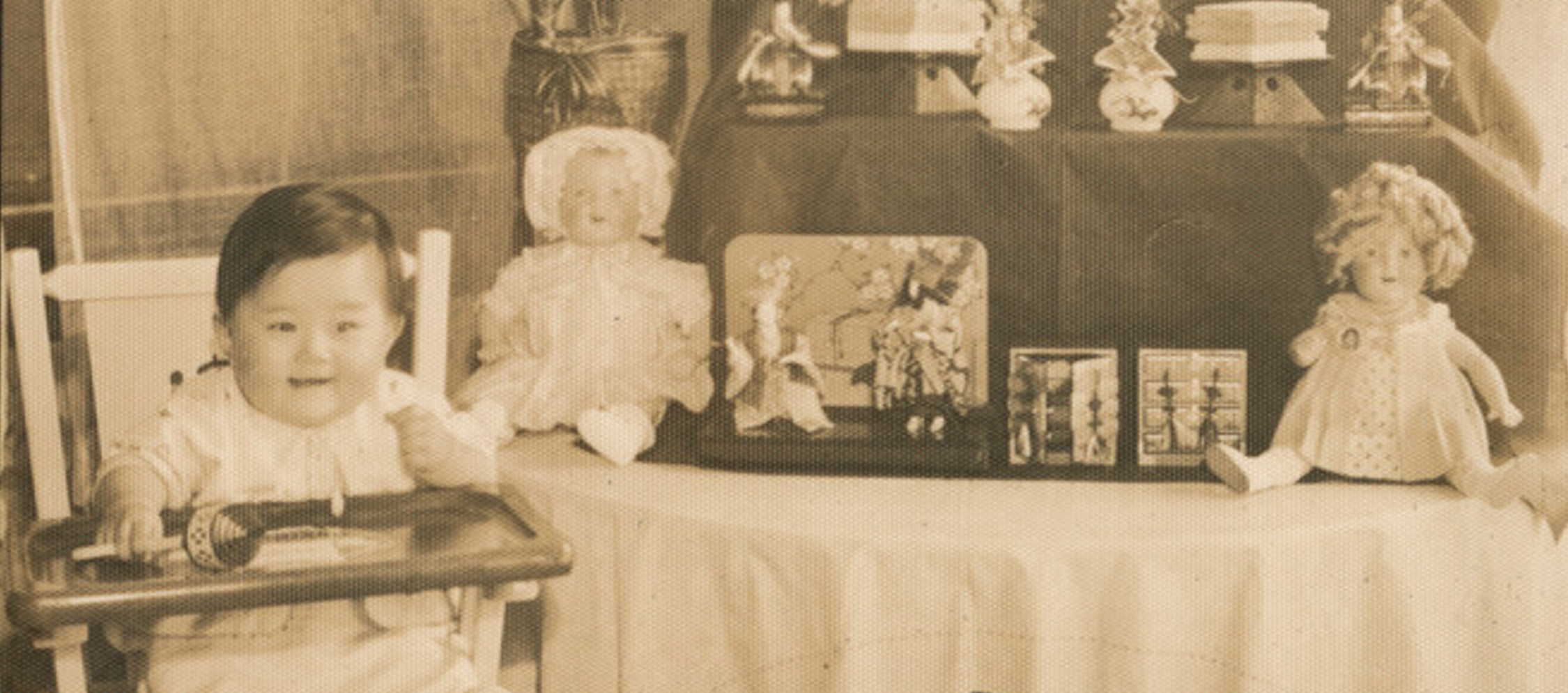
“I lost my dolls.”
This was a familiar lament that my grandmother would share with me as a child. When I would ask my grandmother what was hardest about being incarcerated during World War II, my grandmother would always share the same thing: How sad she was that her collection of Japanese Girls’ Day dolls was lost when she was sent away to camp. Families celebrated Girls’ Day (Hina Matsuri) on March 3rd and Boys’ Day on May 5th to give thanks for the health and prosperity of their children. For Girls’ Day, girls were given sets of Japanese traditional dolls resembling the imperial family. Even decades later, the loss of her precious Girls’ Day dolls still weighed heavily on my grandmother. While many of my family’s belongings were stored by the Japanese Baptist Church in Seattle, the dolls were lost forever.
My grandmother, Toshie “Phyllis” Yorioka, loved dolls, stuffed animals, and the family dogs. Even as an elderly woman, she retained a child-like love for anything kawaii. Her 90s Beanie Baby collection was extensive. I always think of my grandmother smelling of Shiseido face cream and the plumeria leis that she would bring from Hawaii on her visits to my family in Seattle. She had the softest skin of anyone that I’ve ever known, even into her 90s. I often wondered how my soft and sweet grandmother could ever have been seen as an enemy to the government.
When she was 24 years old, my grandmother, along with the entire Japanese American community in Seattle, was sent away from her home after Executive Order 9066 was signed by Franklin D. Roosevelt. My grandmother and grandfather, Joshi “Joe” Yorioka, who was a University of Washington college student at the time, quickly married after their families were sent to the “relocation center” at the fairgrounds in Puyallup so that they could stay together. The new family was then taken to Hunt Idaho to forge a new life at Camp Minidoka. My father was born while my grandparents lived in the camp. When my grandfather was drafted into the US military to work as a Japanese translator for army intelligence because of his Japanese language skills, my grandmother was left alone to take care of her young child in camp.
The Japanese American Incarceration was a pivotal event for my family and all families of Japanese descent. Growing up with the specter of my family’s incarceration, the importance of remembering history has never been lost on me. Avoiding the dangers of politically induced hysteria and demonizing the “foreigner” is increasingly relevant today.
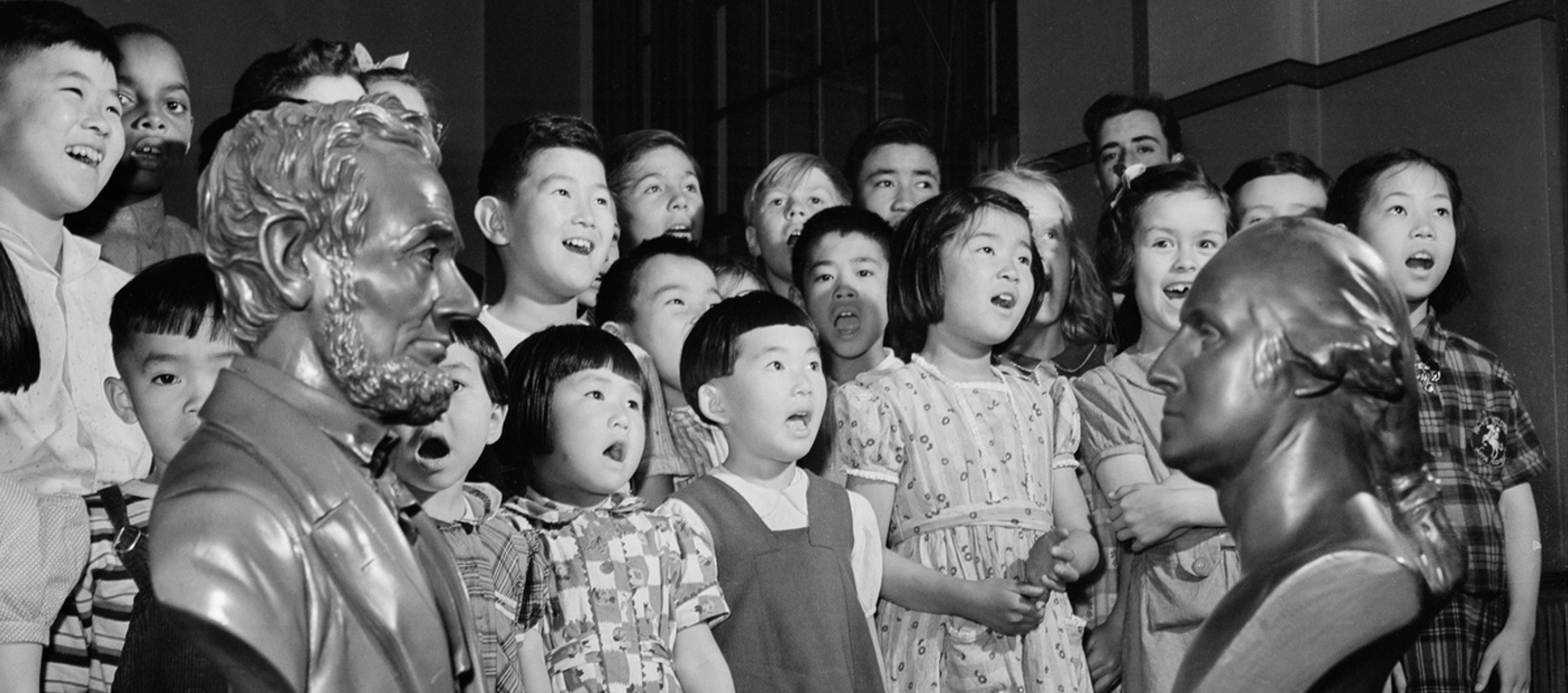
Bailey Gatzert School students singing near statues of Lincoln and Washington, Seattle, 1941. Credit: MOHAI
Last spring, while a student at the University of Washington in the Museology Masters program, I learned of sets of Girls’ Day and Boys’ Day dolls in the Museum of History and Industry (MOHAI) collection. These dolls were left by Japanese families living in Seattle during World War II to Bailey Gatzert Elementary School in the care of the Principal, Ada Mahon. In the 1970s, the collection of dolls was transferred to the historical society and have been at MOHAI ever since.
I had the privilege last summer of working with MOHAI as Guest Curator to research the history of these dolls. My hope from the outset was that I would miraculously be able to find anyone connected with the dolls. One day while digging deep in MOHAI’s extensive archives, I found a single print-out of an email, noting that the family name “Yutani” was found on one of the original boxes. In the early 2000s, Massie Yutani Tomita and her brother came to look at the dolls to see if they could recognize them. After the passing of over 50 years, they could not identify which dolls had come from their family.
In the summer of 2024, I was able to trace down the daughters of Massie Tomita to learn more about their family’s story. Daughter Laura Kusaka graciously agreed to be interviewed via Zoom call all the way from where she now lived in Japan. She shared her mother’s story as a teenager in camp—and her own, as a Japanese American living in Japan. The family shared photos, glimpses into their family’s life over the decades. While the dolls have been long forgotten, the stories of the people connected to these dolls will live on—both, now, in the archives of the MOHAI and in the memories of the next generation.
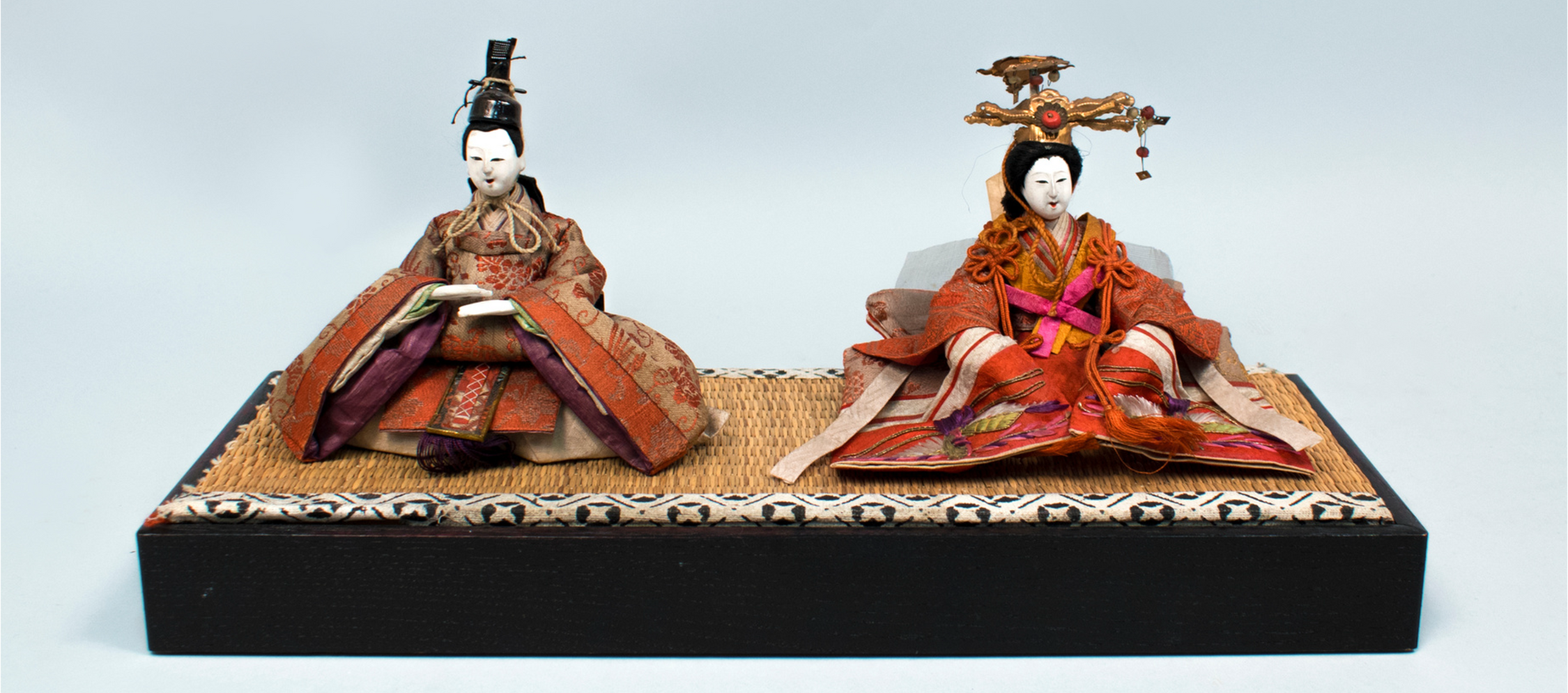
Emperor and Empress dolls that are part of a Japanese Girls’ Day set, 1930-1940. Credit: MOHAI.
The most startling moment in my research process at the MOHAI happened during an email exchange with a staff member at Densho, a nonprofit that has documented the oral histories of Japanese Americans who were incarcerated. In a gracious response to my request for any oral histories or photos connected to Bailey Gatzert Principal Ada Mahon, I received a list of photos. As I scrolled through each photo, one caught my eye: a photo of Principal Mahon visiting Japan in the 1950s to visit her former students. In this photo, Principal Mahon stood smiling at the center, with “unidentified” families next to her. Immediately, I realized she was standing next to my grandmother and father as a young boy. Through my research of these forgotten dolls, I was able to better understand my own family’s story—a story that traces continents and generations, marked forever by the incarceration, but ultimately a story of resilience and love.

Black and white photographic print of Ms. Mahon (center) and unidentified individuals standing outside on lawn. Ms. Mahon served as the principal at Donor’s school, Bailey Gatzert grade school in Seattle, Washington. After Ms. Mahon retired, she visited Tokyo in 1950. Seattle’s Nikkei community raised the funds to pay for Ms. Mahon’s Japan trip. Inscribed on back: “AUG 50/SHINJUKU GARDENS.”
Visit An Immigrant History of Edmonds
Polly Yorioka is the museum curator for the Edmonds Historical Museum, where she curated the new exhibit, “An Immigrant History of Edmonds.” An Immigrant History of Edmonds is a virtual museum featuring the stories of immigrants who have contributed to the rich tapestry of our South Snohomish County community.
“Understanding my identity as the product of immigrants,” she said, “and the daughter of a father who was born in an incarceration camp, has begun to shape my work as a museum practitioner. In a political climate where scapegoating minorities and immigrants has become the norm, I have felt called to use my position of influence as storyteller.”
Visit the exhibit online here, or in person from now until August 23, 2025.
“Museums are spaces where our stories can be remembered,” she says. “My hope is that historical museums can increasingly become places where immigrants and others from diverse backgrounds can encounter their own stories, wrestle with the past and present, develop empathy, and encourage us all to do the radical work of building welcoming communities.”