
How to Be a Chief
On the brink of death, John Halliday was sent a message.
In 2020, John Halliday died after having an allergic reaction to post-op medicine. He would die another two times —once on his way to the hospital in the ambulance and again in the ICU— before falling into a six-day coma.
Even though Halliday appeared to be still during that coma, in his mind he was battling to wake up.
In reality, Halliday comes from a long line of warriors. Although a member of the Muckleshoot tribe, ancestrally his family is Duwamish, originally inhabiting the area that is now known as South Lake Union.
“My great, great, great grandfather was the chief of the Boise Creek band of White River Duwamish, and he led the warriors, along with Leschi, in the attack on Seattle, on January 26, 1856, when 400 warriors surrounded the city and the battleship Decatur drove them off. But ultimately were able to get the governor, Isaac Stevens, to renegotiate the treaty and create the Muckleshoot Reservation,” he said.
Fighting to survive runs in Halliday’s blood.
Perhaps this is why during his coma he dreamed of his Canoe Family. A Canoe Family refers to the group or team of tribal members who journey together on a canoe for the annual Canoe Journey which is hosted by a different tribe every year. Most if not all Northwestern tribes join in on this tradition, but tribes such as the Maori, as well as the Hawaiian and Aleutian peoples, have been known to participate. The journey brings hundreds of Canoe Families together to different shores yearly.
In his dream, his Canoe Family was trying to break him out of the hospital, singing to him from outside. Later in his dream he saw his limp body inside a longhouse, being devoured by snakes.
“‘You don’t have to be afraid,” he thought to himself.
Suddenly a white wolf and coyote, his spirit helpers, or Tamanawas as it’s known in the Salish language, appeared to him. He then became the white wolf and defended his body from the snakes. All the while, his Canoe Family marched into the longhouse singing that their land is heaven and is full of chiefs. That’s when Halliday had a realization.
“I remember my mom told me that we had all kinds of different chiefs,” he said. “We had peace chiefs, war chiefs, chiefs in charge of hunting, chiefs in charge of fishing, chiefs in charge of gathering, chiefs in charge of the fire, chiefs in charge of watching the camp, both men and women… but what they all had in common was caring for others.”
When Halliday finished defeating the last snake, his Canoe Family handed him his own paddle and he walked out of the longhouse. That’s when he woke from his coma.
At 55, he opened his eyes but could barely see. Halliday is now legally blind. His sight is so limited that any glasses he uses must “blow things up so big that in order for me to see it clearly in focus, it has to be so big that it’s almost as if I’m standing next to a letter,” he explained.
“After my [hospitalization], I introduced myself as a father and a husband, and I learned that those were really the important titles. That’s how I should have been introducing myself all along,”
Halliday’s life completely changed. Initially, it seemed like his own chief-like roles were being stripped from him all at once. “I was doing congressional and presidential correspondence. I was in charge of 17.5 million acres of Indian reservation,” he recalls. “I handled realty, probate, natural resources, range and agriculture, environmental compliance, engineering, and wildfires.”
Unable to read, write, or use technology, Halliday resigned from his role as the deputy regional director for the bureau of Indian affairs for the Navajo region.
“I came home and I couldn’t even get my key in the door,” he adds.
At first, losing all these titles felt like a loss of identity and purpose. But Halliday’s voice begins quavering not at the admission of this, but rather at the recognition that the more prominent roles he identifies with now should have always come before the ones he now forgoes.
“After my [hospitalization], I introduced myself as a father and a husband, and I learned that those were really the important titles. That’s how I should have been introducing myself all along,” he said.
It took all of six months to find a new purpose. Before losing his sight, “artist” was never a title he ever identified with before. With the help of his wife, Halliday obtained paints, canvases, and the inspiration to create his first work of art: “Bear Hope.”
Halliday is now traveling the state as part of Humanities Washington’s Speakers Bureau, telling his story, sharing his art, and exploring what it means to be a chief through his public talk, “What Is a Chief? How Native Values Can Teach Resilience.”

John Halliday.
What’s immediately apparent is that Halliday doesn’t need perfect vision to paint captivating images. According to Halliday, although he is blind, he sees his paintings in his mind, much like the dream he had during his coma.
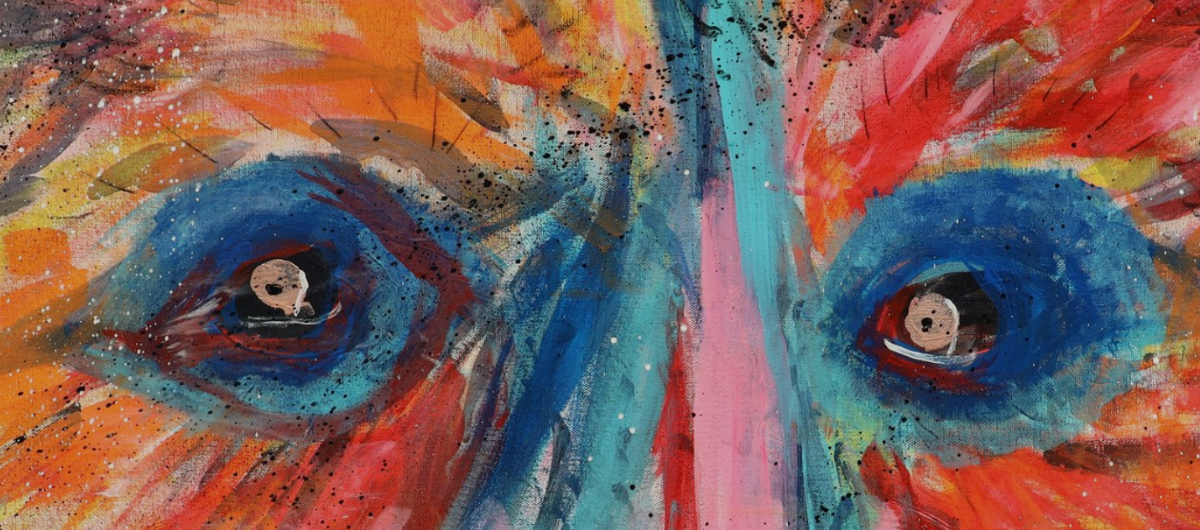
In “Bear Hope,” two cool eyes balance between a stoic snout. They watch intently, popping out at the viewer from the surrounding fur that burns like embers.
Halliday didn’t so much become an artist as much as he returned to his roots, recalling how his father, a gallery curator, encouraged him from a young age to charcoal paint and create cultural regalia.
Halliday has now painted many other works including “White Buffalo Medicine,” and “The Salmon People.” He has also dedicated himself to making Native American regalia like eagle staffs and war bonnets.
In 2023, he was flown out to Denmark by artist Thomas Dambo, best known for his wood palette trolls found all around Washington State. In Denmark, Dambo commissioned Halliday to paint a mural on his house.
With the help of an assistant, Halliday created the outline by standing far away from the wall and marking the shadows cast upon a cut out placed three inches from his face. This way, the assistant could wave the brush and paint the wall based on the shadows Halliday could see on the cut out, sort of like how a pinhole camera allows a person to see an eclipse without staring directly into the sun.
An Orca whale now lives permanently on the facade of Dambo’s home.
In thinking back on his coma dream and the appearance of his Canoe Family, Halliday thinks his culture not only helped him overcome his disability, but taught him his purpose and a powerful lesson.
“Being a chief is about father helping son, daughter helping friend, mom helping granddaughter, friend helping friend. All of those are acts of being a chief, and you have to ask yourself when you have moral questions: What would a chief do? Are you being a chief by what you’re doing right now?”
He added, “I believe that I was brought back to bring this message to you: that we can all be chiefs in our own way.”
Agueda Pacheco Flores is a freelance writer in Seattle who focuses on social justice issues, music, arts, and the Latine diaspora. She’s previously written for The Seattle Times, Crosscut, Journey Magazine, Real Change News, and The South Seattle Emerald.
John Halliday is delivering a talk, What Is a Chief? How Native Values can Teach Resilience, as part of Humanities Washington’s Speakers Bureau. Check it out online or in-person around the state. Find an event here.